

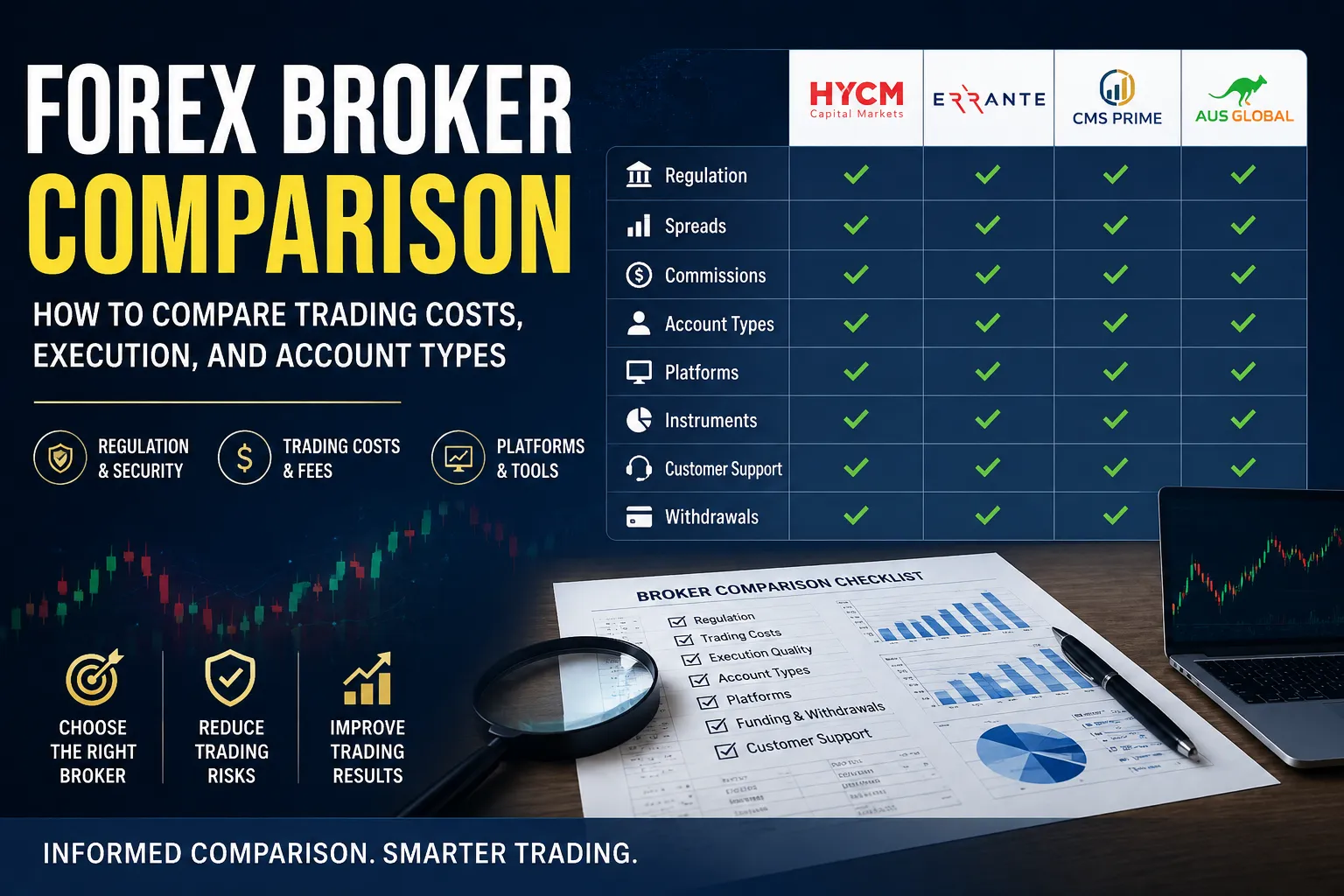
Choosing a Forex broker is not simply a matter of finding the lowest advertised spread. A useful Forex broker comparison should examine the leg entity that will hold the account, the total cost of trading, order execution, available account types, trading platforms, withdrawal procedures, and whether the broker’s conditions match the trader’s strategy.
A broker that appears inexpensive on a promotional page may become more costly after commissions, swaps, slippage, or wider spreads during volatile market conditions are considered. Likewise, a broker with a broad range of platforms may not be the right fit if its account structure does not support the trader’s preferred position size or trading frequency.
The most effective way to compare brokers is to use the same criteria for every company and evaluate the final trading conditions rather than relying on a single headline number.
Why a Forex Broker Comparison Should Go Beyond Spreads
The spread is the difference between the bid and ask price. It is an immediate trading cost, but it is only one part of the overall cost.
Consider two hypothetical EUR/USD accounts:
| Account | Average Spread | Commission | Estimated Cost for One Standard Lot |
|---|---|---|---|
| Account A | 1.2 pips | $0 | Approximately $12 |
| Account B | 0.2 pips | $7 round turn | Approximately $9 |
If one pip is worth approximately $10 for one standard EUR/USD lot, Account B may have a lower estimated transaction cost despite charging a commission.
However, this calculation is incomplete if execution quality differs. A lower quoted spread may provide little advantage if orders experience frequent slippage or if spreads widen significantly during the hours when a trader is active.
A structured broker comparison should therefore consider:
- Spread
- Commission
- Swap or overnight financing
- Slippage
- Order execution
- Deposit and withdrawal charges
- Platform-related costs
- Currency-conversion fees
Independent broker-review methodologies also assess several categories rather than relying only on pricing. These can include regulation, trading costs, available instruments, platforms, mobile features, research, education, customer support, and security.

1. Check the Legal Entity and Regulation
The first question should not be “How low are the spreads?” It should be:
Which legal entity will open and maintain the trading account?
Some broker groups operate through multiple companies in different jurisdictions. The same brand may offer different leverage limits, investor protections, compensation arrangements, or trading conditions depending on the client’s country and the entity assigned to the account.
Before registering, check:
- The full legal company name
- The regulator listed for that entity
- The licence or registration number
- The country in which the entity is authorised
- Whether the regulator’s public register confirms the information
- The protections that apply to the specific account
Regulation is not a guarantee against losses or operational problems. It does, however, provide an important framework for supervision, client-money rules, disclosures, and complaint procedures.
Traders should also avoid assuming that a well-known brand name automatically means every account receives identical regulatory protection.
2. Calculate the Real Cost of Trading
A useful Forex broker comparison measures the cost of a complete trade rather than comparing only minimum spreads.
The basic calculation can be expressed as:
Total Trading Cost = Spread Cost + Commission + Swap + Other Applicable Fees
For example, assume a trader opens and closes one standard lot of EUR/USD:
- Average spread: 0.4 pips
- Approximate pip value: $10
- Spread cost: $4
- Round-turn commission: $6
- Estimated direct transaction cost: $10
If the position remains open overnight, swap may add another cost or credit. The final result depends on the instrument, trade direction, account type, and current financing conditions.
Minimum spreads should be interpreted carefully. A broker may advertise spreads “from 0.0” or “from 0.1 pips,” but those figures may represent the lowest available price under specific conditions rather than the spread a trader experiences throughout the day.
For example, HYCM publishes multiple account structures, including fixed, classic, and raw accounts. Its published account information lists raw spreads from 0.1 pips, while commissions and conditions vary by account and instrument. The broker also notes that displayed spreads are indicative and that actual values may be seen in the trading terminal.
When reviewing a broker such as HYCM, the useful comparison is not simply “Does it offer low spreads?” It is:
Which account type fits the trader’s volume, strategy, platform, and expected trading hours?
For additional broker profiles and structured comparisons, readers can explore BrokerDecider and review the published broker information alongside each broker’s official terms.

3. Compare Account Types by Trading Style
Account types are often designed around different pricing models.
Standard or Classic Accounts
These accounts may include trading costs primarily within the spread and may charge no separate commission.
They can be easier to understand because the cost is visible in the quote. However, the spread may be wider than on a raw-spread account.
They may suit traders who:
- Trade less frequently
- Prefer simple pricing
- Use larger timeframes
- Do not require extremely tight intraday spreads
Raw or Commission-Based Accounts
Raw accounts generally offer narrower quoted spreads while charging a separate commission.
They may be more relevant for:
- Scalpers
- Active day traders
- High-frequency strategies
- Traders who calculate costs precisely
The lower spread does not automatically make a raw account cheaper. The commission must be included in the calculation.
Fixed-Spread Accounts
A fixed-spread structure may provide more predictable pricing under normal conditions. However, traders should read the terms carefully because fixed spreads may widen during certain sessions, low-liquidity periods, or exceptional market conditions.
Swap-Free Accounts
Swap-free accounts are designed to remove or modify overnight financing charges under specific conditions. Their availability, fees, holding limits, and eligible instruments can vary.
A trader should compare the complete account specification rather than assuming that “swap-free” means “cost-free.”

4. Order Execution and Slippage
Execution quality is harder to compare than spreads because it is not always visible before opening an account.
Important questions include:
- How are market orders executed?
- Are requotes possible?
- What happens during rapid price changes?
- Are stop-loss orders subject to slippage?
- Does the broker publish execution statistics?
- Are there restrictions on scalping, news trading, or automated strategies?
Slippage occurs when an order is filled at a price different from the requested or expected price.
Suppose a trader sends a buy order at 1.10000, but the order is filled at 1.10015. The difference is 1.5 pips of negative slippage.
Positive slippage can also occur, although traders often focus on negative outcomes.
Execution quality may become particularly important during:
- Non-Farm Payrolls
- Inflation releases
- Central-bank decisions
- Market openings
- Sudden geopolitical events
A trader who holds positions for weeks may consider execution quality less critical than a scalper entering and exiting several times per day. The comparison should reflect the strategy.
5. Platforms and Trading Tools
A platform is more than a charting interface. It affects order placement, analysis, automation, alerts, and trade management.
Common platform considerations include:
- MetaTrader 4
- MetaTrader 5
- Proprietary web platforms
- Mobile applications
- Automated trading support
- Custom indicators
- Charting tools
- Order types
A trader who uses Expert Advisors should verify that automated trading is permitted on the selected account.
HYCM lists support for MT4 and MT5 across several account options, while its available platforms and account conditions should be checked for the relevant region and legal entity.
When reviewing Errante, CMS Prime, or AUS Global, traders should use the same process: confirm which platforms are available to their region, whether the preferred account supports the intended strategy, and whether platform features are consistent across desktop, web, and mobile versions.
A broker should not be considered better simply because it offers more platforms. The relevant question is whether the available platform supports the trader’s workflow.

6. Compare Available Markets
Different brokers may provide access to different combinations of:
- Major and minor currency pairs
- Exotic currencies
- Precious metals
- Energy products
- Stock indices
- Shares or share CFDs
- Cryptocurrencies
- Other derivatives
A trader focused only on EUR/USD may place more importance on execution and pricing than on the total number of instruments.
A multi-asset trader may value broader market access.
HYCM states that its product range includes Forex, shares, indices, cryptocurrencies, and commodities, although availability and conditions can depend on the account and jurisdiction.
The number of instruments should therefore be treated as a secondary metric unless the trader actively needs those markets.
7. How Four Broker Brands Can Be Compared
A meaningful comparison does not require declaring one broker universally better than another. Instead, each broker can be evaluated using the same framework.
HYCM
A review of HYCM may focus on:
- The legal entity available to the client
- Fixed, classic, and raw account structures
- Spread and commission calculations
- Platform availability
- Instrument coverage
- Applicable leverage and protections
HYCM reports more than 300 instruments and multiple account types, but published conditions should be checked against the specific account and jurisdiction.

Errante
When comparing Errante, traders may examine:
- Available account categories
- Spread and commission structure
- Supported platforms
- Minimum trading volume
- Trading instruments
- Funding and withdrawal procedures
The relevant question is whether its available conditions match the trader’s approach—not whether the brand has the most features.
CMS Prime
A review of CMS Prime can focus on:
- Account pricing
- Execution model and available information
- Platform support
- Market access
- Trading restrictions
- Client onboarding and support
Active traders may place greater weight on execution, costs, and platform stability than on educational content.
AUS Global
When evaluating AUS Global, traders can compare:
- The entity serving their region
- Account options
- Spreads and commissions
- Platform access
- Instrument availability
- Deposit and withdrawal methods
The same rule applies to every broker: published conditions should be verified before funding an account because product specifications may change.
For Persian-language Forex education, market explanations, and trading guides, readers can also visit GoogleForex.
8. Match the Broker to the Strategy
Different trading styles create different priorities.
| Trading Style | Higher-Priority Factors |
|---|---|
| Scalping | Tight all-in costs, fast execution, low slippage |
| Day Trading | Spreads, commissions, platform stability, news execution |
| Swing Trading | Swap rates, charting, market access |
| Position Trading | Financing costs, account security, long-term support |
| Automated Trading | EA support, platform reliability, trading restrictions |
For example, a trader who opens two positions per month may not benefit much from paying for the lowest possible intraday spread. A trader who executes 20 short-term trades per day may consider small differences in all-in costs highly significant.
The best broker is therefore not a universal ranking. It is the broker whose conditions align with the trader’s strategy and account requirements.

9. Test Deposits and Withdrawals Before Committing Large Capital
Funding procedures are part of the broker experience and should be tested carefully.
Before depositing a large amount:
- Check supported payment methods
- Review processing times
- Confirm possible third-party fees
- Check withdrawal requirements
- Verify whether the withdrawal method must match the deposit method
- Read identity-verification rules
A small deposit and withdrawal test can provide practical information about processing, communication, and account procedures.
Traders should keep records of:
- Deposit confirmations
- Withdrawal requests
- Account statements
- Support conversations
- Trade reports
These records may be useful if a dispute occurs.
10. A Practical Forex Broker Comparison Checklist
Before opening an account, answer these questions:
- Which legal entity will hold my account?
- Is the entity listed on the regulator’s official register?
- What is the average spread for the instruments I trade?
- Is there a commission?
- What are the overnight financing costs?
- Is my strategy permitted?
- Which platform is available?
- Does the account support automated trading?
- What is the minimum trade size?
- What happens during high-volatility events?
- Which deposit and withdrawal methods are available?
- Are there inactivity, conversion, or account-maintenance fees?
- Is customer support available when I trade?
- Can I test the platform through a demo account?
The answers should be recorded in the same format for every broker. This reduces the risk of comparing one company’s minimum spread with another company’s average spread or comparing account types with different commission structures.

Final Thoughts
A useful Forex broker comparison should measure more than the lowest advertised spread. Regulation, legal entities, all-in trading costs, execution quality, account types, platforms, market access, and withdrawal procedures can all affect the trading experience.