


Lightening the candle on the tomb is one of the old and meaningful traditions seen in different cultures and religions of the world. This is not only a simple tradition but also has psychological, religious and symbolic aspects.
Psychoanalysis
From a psychology point of view, lighting candles on the tombstone is not only a traditional or simple ritual, but as one of the most profound and influential ways to maintain and maintain an emotional bond between the person in the past and the survivors. The candle’s flaw, in the silence of the cemetery, can be a light in the darkness of the heart; The light that is reminiscent of love, common memories, and the continuation of communication that even death cannot be ruptured. This act as a symbolic ritual makes the mourning process easier and allow survivors to accept the absence and continue living with their loved ones.
Why do dates and halva spread
The broadcast of halva and dates in mourning and termination is rooted in culture, religion and social psychology, and its reasons can be examined in several dimensions:
Religious and traditional root
In Islamic culture, doing good to the intention of a deceased person is a good and rewarding thing. Food distribution, such as halva and dates, is a kind of charity with the intention of the deceased’s forgiveness. Islamic traditions have also emphasized that giving and giving alms to the underworld can have mercy and peace.
Symbolic aspect of foods
Dates in the Qur’an are introduced as a fruit of Paradise and symbolize freshness, life, and divine prosperity. Eating it at the mourning ceremony is reminiscent of God’s blessings and prayer for the deceased to enter Paradise.
Psychological dimensions
In the face of death, people need signs that lead them to empathy, mourning, and reducing existential anxiety. Accepting others with foods such as dates and halva allows survivors to feel sympathy for those around them and experience social support in their mourning process.
For more information on the philosophy of dates and halva, you can go to an article in Benefit Stone Titled “Why do they broadcast dates and halva at the mourning ceremony?“Published, see.
Religious
In the Islamic religion, lighting candles or lights on the tomb is known as a must -have. According to Islamic traditions, the lights of the deceased’s burial are recommended so that both pilgrims can easily visit and be a symbol of light and guidance for the soul. For example, in the book, in the book, in the book, in the book, in the book Al -Shi’a means It is said: “One of the essentials is that when someone died at night, it is better to light a lamp with Mate.”
It is also quoted that Imam Sadiq (AS), after the testimony of Imam Baqir (AS), ordered that the house they lived, to light a light. This shows that lighting in sacred and memorial places is of particular importance and is regarded as a sign of respect and commemoration.
Lightening the candle in different religions
This custom is not limited to Islam and has a special place in other religions:
Christianity
In Christianity, candles are a symbol of the light of Christ and the hope of life after death. In the churches and memorials, candles are lit to show divine presence and communication with the spiritual world.
Buddhism
In Buddhism, brightening the spiritual candle is to achieve the peace of mind and is performed as part of the meditation and memorial.
Hinduism
In this religion, candles are illuminated as a symbol of sacred and purity at religious and memorial ceremonies.
Judaism
At the Jewish mourning and memorials, the candles are lit to remember the deceased and their light symbolizes the immortality of the soul.
The importance of the candle color in a variety of ceremonies
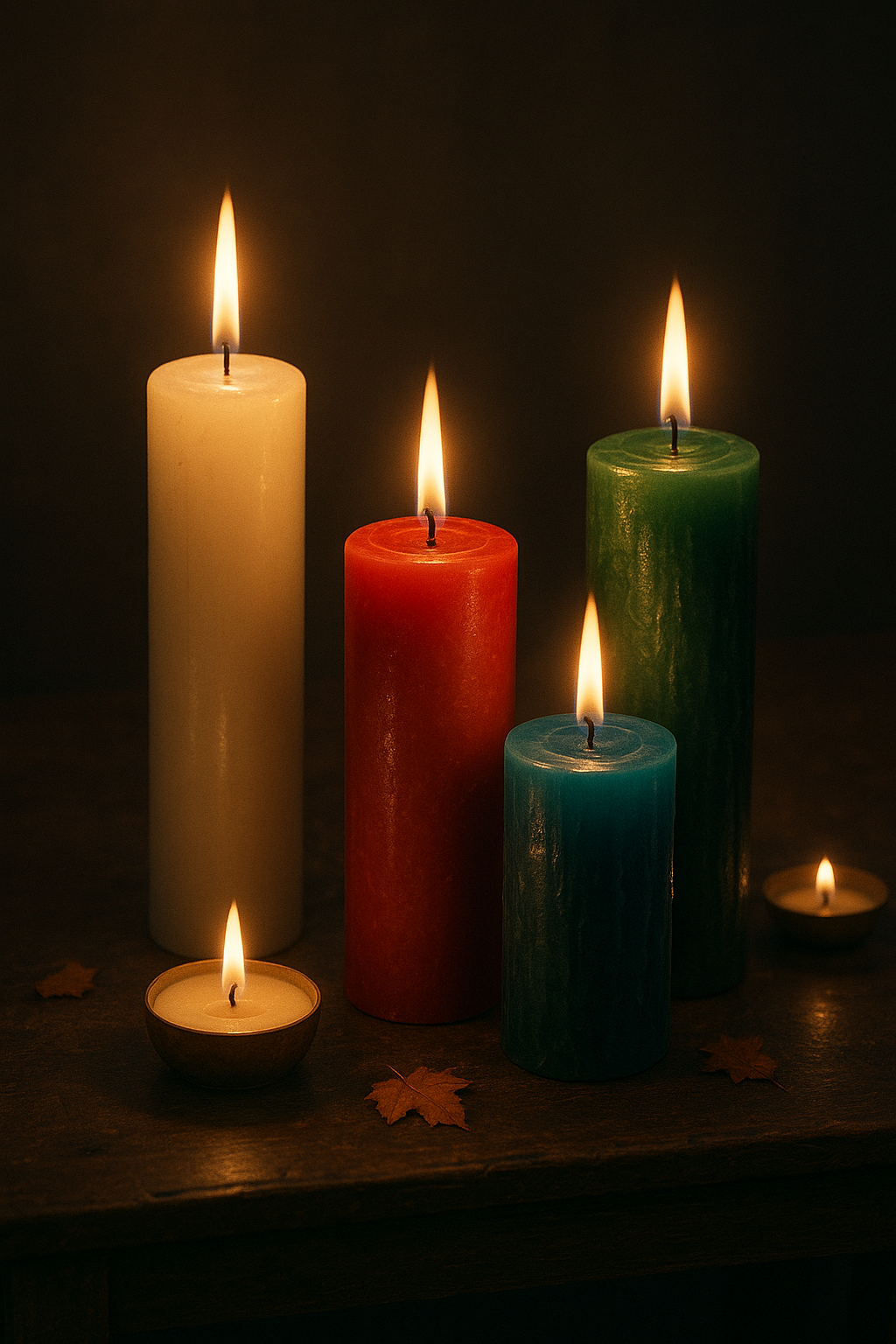
The color of the candle plays an important role in some cultures and beliefs. For example
White candle
In many cultures, white candle is a symbol of purity, innocence and peace, and in the memorial, it is regarded as a sign of pure spirit in the past.
Red Candle
In Christianity, especially at Easter, it is a symbol of the blood of Christ, and sometimes it is clear to show love and sacrifice.
Green or blue candle
In Feng Shui, these colors are used to absorb energies such as wealth (green) or calm (blue).
Black candle
Black candles are often tied to concepts such as mourning, the end of a period, protection against negative energies, and even internal reconstruction.
In some spiritual or magical traditions (for example in Vika or cleansing), lighting a black candle is used to repel negative energies or close a season of life. Although less common in Iranian or Islamic culture, in some Western ceremonies, there is also a symbol of power, seriousness, silence and introspection.
However, in Islam, more emphasis is on the act of lighting candles or lights as respect and commemoration, and the color of the candle is less important. The choice of color depends more on personal culture and taste.
Conclusion
Lighting candles on the tomb is a practice that is rooted in psychology, religion and culture. As mentioned, psychologically, this custom helps the survivors to cope with the feeling of lack and loss of their beloved. In Islam and other religions, lighting candles or lights is a symbol of respect, memorial and spiritual guidance. The color of the candle also has certain meanings in some cultures. But in the end, it depends on the intention and feeling of its back. The distribution of dates and halva as part of the ceremony also brings the memory of the deceased. This customs reflect the efforts of human beings to maintain a relationship with loved ones and commemorate them.