

Published in Global Workforce & EdTech Insights
The Structural Flaws of Legacy Credentialing
The global labor market moves faster than ever, but its verification infrastructure remains largely anchored in the past[cite: 1]. For decades, educational institutions, training providers, and professional associations relied on physical certificates, scanned PDFs, or complex third-party background checks to validate competencies[cite: 1]. In a modern recruitment landscape characterized by remote talent acquisition and cross-border hiring, these static documents present glaring security vulnerabilities[cite: 1]. They are easily doctored, trivially forged, and administratively exhausting to verify manually[cite: 1].
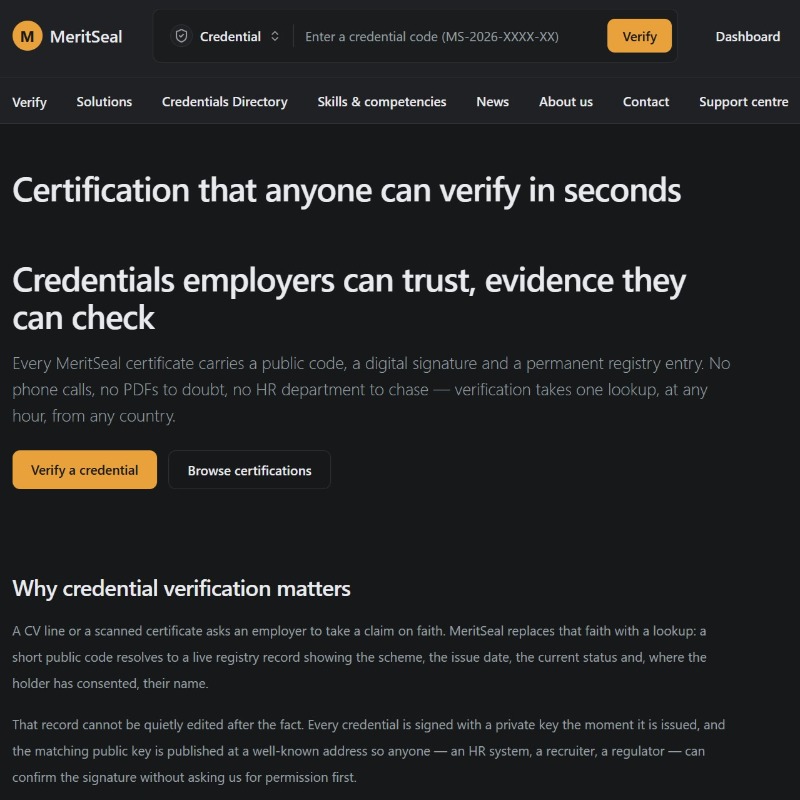
As qualification fraud continues to rise, organizations are turning toward open, tamper-evident ecosystems to authenticate candidate claims[cite: 1]. At the forefront of this transformation is the MeritSeal credentialing platform , an end-to-end framework built to convert professional certifications into universally verifiable, real-time public infrastructure[cite: 1].
Cryptographic Integrity: Moving Beyond Paper and PDFs
The primary innovation behind modern digital credentialing is the use of cryptographic key pairs to guarantee authenticity[cite: 1]. Every issued credential is tied to a private signing key and published alongside publicly inspectable records[cite: 1]. Verifying parties can easily cross-reference credentials against established public verification keys via an open JWKS (JSON Web Key Set) endpoint[cite: 1].
This zero-trust architecture ensures that any post-issuance tampering—such as altering candidate names, manipulating passing grades, or artificially extending expiration dates—breaks the cryptographic signature immediately[cite: 1]. Rather than storing records in siloed, proprietary databases that require lengthy authentication workflows, verification is handled through a stateless, high-availability public registry accessible around the clock[cite: 1].
Setting the Benchmark: Human-Governed Competency Standards
Technology alone cannot guarantee that a certification reflects genuine domain mastery[cite: 1]. The credibility of any credentialing system ultimately rests on the rigor of its assessment criteria[cite: 1]. To maintain high institutional value, assessment frameworks must align with well-defined skills and competency standards , supported by psychometric reviews, subject-matter expert panels, and clear cut scores[cite: 1].
Furthermore, ethical governance requires that algorithms do not make critical, life-altering administrative determinations unchecked[cite: 1]. While the issuance and validation pipelines operate automatically, candidate appeals, special policy exceptions, and credential cancellations are strictly governed by human review panels[cite: 1]. When compliance violations occur, records are instantly updated on the central credential revocation list , ensuring immediate, transparent status changes for recruiters and regulatory bodies[cite: 1].
Seamless Integration for Employers and Working Professionals
To be effective, modern verification systems must offer straightforward workflows that reduce friction for all parties involved in the hiring lifecycle[cite: 1]:
- For Ambitious Professionals: Candidates who complete proctored or unproctored evaluations receive a permanent, unique credential code[cite: 1]. This identifier can be placed in digital resumes, LinkedIn profiles, and email signatures, allowing applicants to provide instant proof of their skills to prospective employers[cite: 1].
- For Issuers and Enterprise Bodies: Training academies, certification providers, and enterprise firms can deploy dedicated professional credentialing solutions to handle cohort tracking, automated bulk issuance, and compliance auditing without maintaining complex internal server systems[cite: 1].
- For Verifiers and Recruiters: Talent acquisition teams no longer need to wait days for university registrars or background check firms to confirm qualifications[cite: 1]. By querying a credential’s public code, recruiters can instantly inspect the candidate’s active status, issuance date, and assessment framework at zero cost[cite: 1].
The Future of Workforce Trust
As technical domains diversify and distributed teams become standard practice, the need for verifiable, portable professional identities will continue to grow[cite: 1]. Modern credential registries are eliminating the friction of manual verification while setting a robust standard for professional authenticity and transparency[cite: 1].