

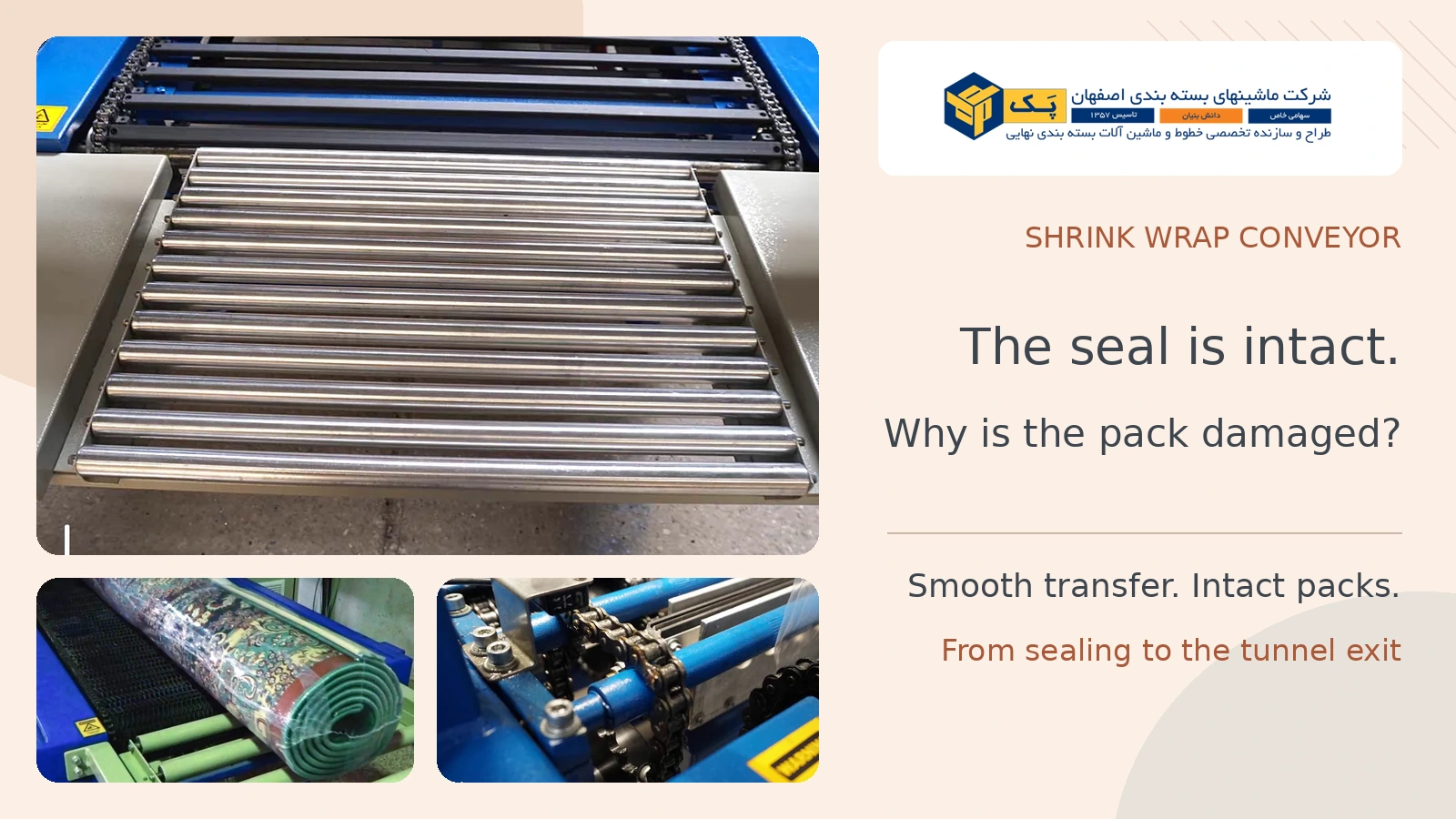
The seal looks intact. So why does the package arrive damaged?
Package quality depends on smooth, well-supported movement throughout the shrink wrapping line.A package leaves the sealing section looking correct. At the tunnel exit, however, its film is scuffed, its contents have shifted, or its seal has started to separate. Before changing sealing settings, examine what happened along the way.
The shrink wrap machine conveyor is more than a transport mechanism. Its support surface, motion, and transfer points influence the forces acting on the package. A poorly matched conveyor can damage otherwise acceptable wrapping, while a well-designed transfer system helps preserve quality from sealing through discharge.
Why Conveyor Quality Matters Beyond Product Movement
A conveyor must support the product without catching loose film, destabilizing the load, or creating excessive drag. This becomes especially important when packages cross between machine sections or move while their film is still warm.
Depending on the film and sealing process, a newly formed seal may need time to cool before it withstands handling forces reliably. After shrinking, warm film can also be more vulnerable to marking or distortion. Abrupt acceleration, unsupported edges, and rough contact surfaces can place stress exactly where the package is least able to tolerate it.
When comparing shrink wrap machines, evaluate the complete product path—not just the sealing unit, tunnel dimensions, or advertised output.
Match the Conveyor Surface to the Product and Operating Conditions
No conveyor surface is ideal for every application. Selection should consider product weight, footprint, stability, film characteristics, and the temperature at the installation point.
| Selection factor | What to check | Why it matters |
|---|---|---|
| Product weight and footprint | Load rating, support spacing, and deflection under load | Insufficient support can allow sagging, tipping, or concentrated contact pressure. |
| Operating temperature | Temperature ratings of the belt, rollers, coatings, and related components | A surface suitable for an infeed section may not be suitable inside a shrink tunnel. |
| Film compatibility | Adhesion, friction, surface finish, and release behavior during testing | Unsuitable contact conditions can cause sticking, scuffing, or film distortion. |
| Product stability | Support continuity and guide arrangement | Small, tall, round, or uneven products may require different handling provisions. |
| Cleaning requirements | Access, approved cleaning methods, and residue removal | Accumulated contamination can affect movement and damage the package surface. |
Roller, mesh, and modular conveyors each have application-specific advantages and limitations. Roller spacing must suit the product base; mesh must be checked for damaged wires and suitable contact characteristics; modular belt materials must be rated for their actual environment. Appearance alone cannot establish suitability.
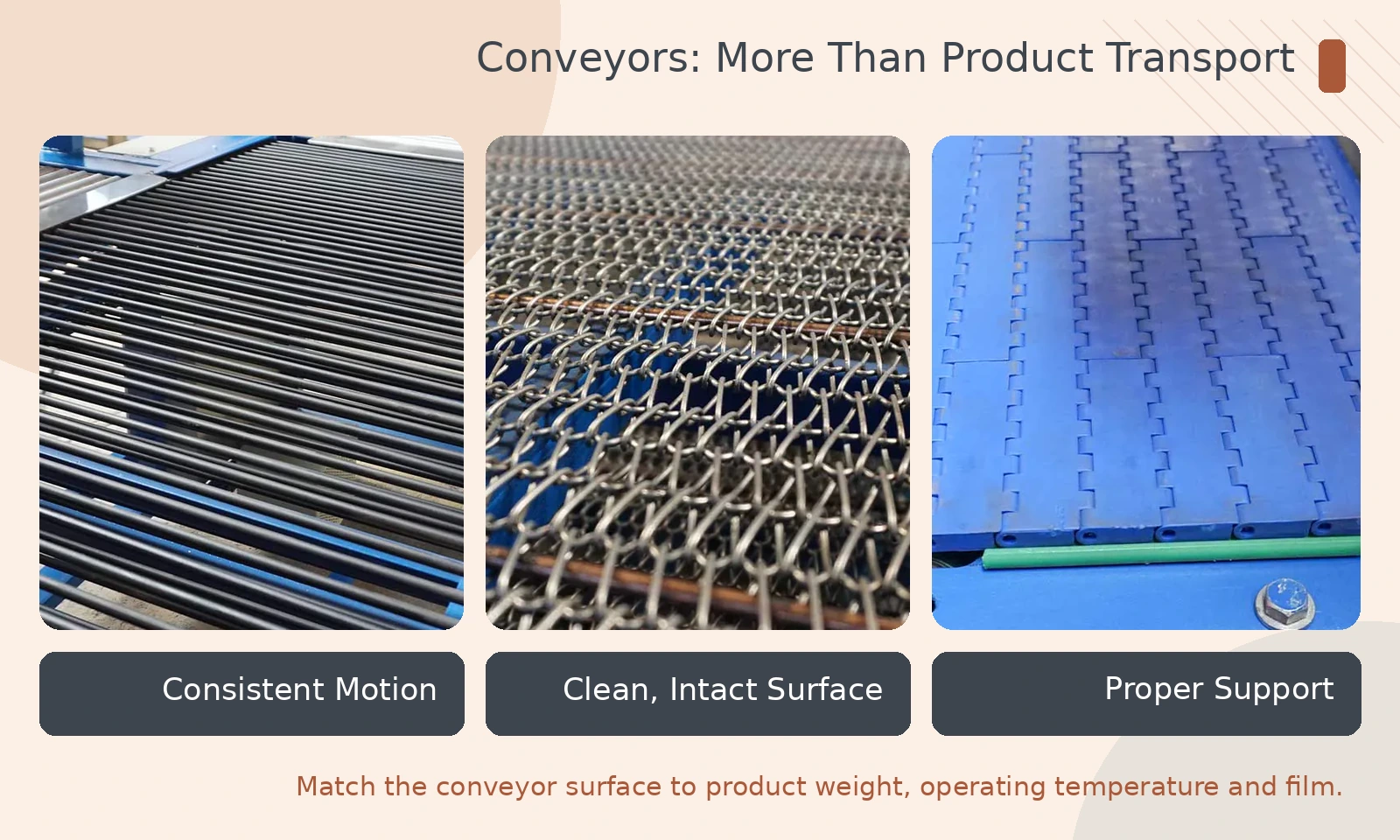 Suitable support, a clean contact surface, and consistent motion work together to protect the package.
Transfer Gaps: Small Discontinuities, Significant Damage
The connection between two conveyors is often a critical inspection point. An excessive gap can allow a small product to dip or loose film to catch. A height mismatch can create an impact, tilt a tray, or make the package drag across an edge.
Inspect transfers at the sealing-section discharge, tunnel entrance, tunnel exit, and downstream handling equipment. Check their behavior under representative loads, because a transfer that appears level when empty may behave differently during production.
Transfer plates or other bridging arrangements may help in suitable applications, but their edges, friction, temperature exposure, and guarding must be considered. Any modification should be assessed by the machine supplier or a qualified engineer rather than improvised during operation.
Speed Coordination Is More Important Than a Single Speed Setting
When a package spans two sections moving at different surface speeds, it may slip, rotate, or experience pulling forces. If the downstream section cannot clear products quickly enough, packages can accumulate and press against one another.
However, every conveyor does not necessarily need to run at the same speed. Some lines intentionally use controlled speed differences to create spacing. The requirement is a coordinated transfer that handles the product without damaging the film or disrupting its position.
- Observe actual package motion rather than relying only on displayed speed values.
- Check acceleration and deceleration during normal, approved operating sequences.
- Look for vibration, belt wandering, roller irregularities, or intermittent hesitation.
- Confirm that package spacing remains suitable at the intended production rate.
A smooth empty-belt demonstration is not enough. Test the conveyor with the products and loading conditions it will actually encounter.
Film Sticking, Surface Marks, and Seal Damage: What to Investigate
Damage patterns provide clues, not proof. Trace where the defect first appears before deciding which component is responsible.
| Observed symptom | Mechanical checks |
|---|---|
| Film sticking to the conveyor | Residue buildup, damaged contact surfaces, material compatibility, and film release at discharge |
| Repeated scratches or punctures | Sharp edges, broken mesh wires, protruding fasteners, and rough transfer plates |
| Seal damage after transfer | Film snagging, unsupported package sections, sudden pulling, and contact with guides |
| Shifted contents or tilted packs | Transfer gaps, height differences, sudden motion changes, and insufficient support |
| Uneven spacing or package collisions | Speed coordination, slipping, downstream restrictions, and feed timing |
Film sticking and seal failure can also involve film properties or process conditions. If mechanical checks do not explain the defect, broaden the investigation with the supplier. Do not assume that every damaged seal began as a sealing fault—or that every fault can be corrected at the conveyor.
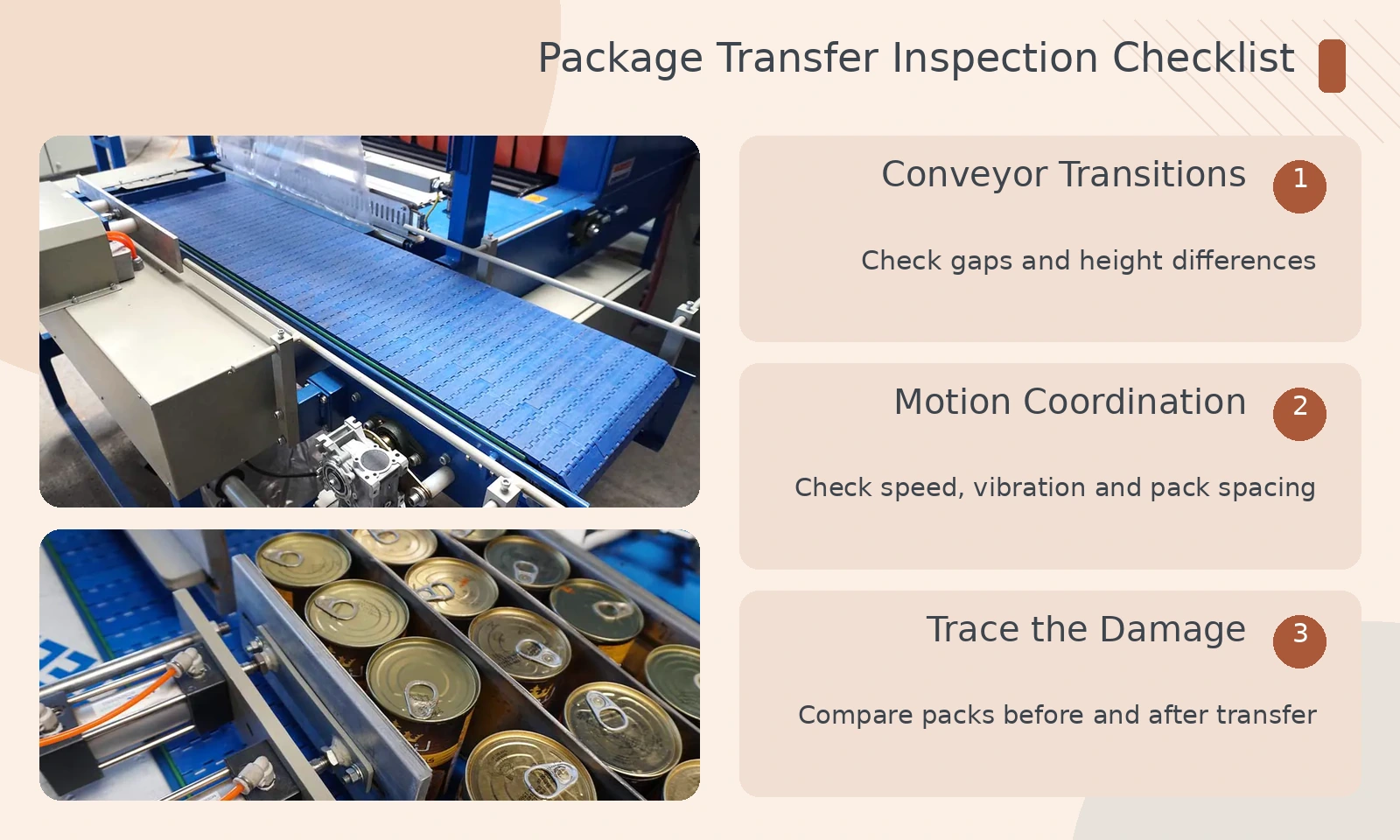 Inspect connections, movement coordination, and the first location where package damage becomes visible.
Inspection Checklist: Follow the Package from Sealer to Exit
Use this checklist during a pre-purchase trial or a structured quality investigation.
- Choose representative products. Include lightweight, heavy, small-footprint, or unstable items where relevant to your actual production range.
- Use production materials. Test the intended film, trays, cartons, and product arrangement.
- Establish the starting condition. Observe package and seal condition after sealing through a safe viewing point or approved sampling procedure.
- Map each transfer. Record gaps, height differences, support changes, and locations where film could contact an edge.
- Watch movement under load. Look for rocking, hesitation, sliding, vibration, and changes in spacing.
- Test continuous production. After the machine reaches normal operating conditions, run at the agreed throughput for an agreed duration.
- Compare stages. Use safe observation or approved sample collection to identify where damage first appears. Never reach into moving machinery.
- Assess cooled packages. Check the underside, corners, seal area, and product position after cooling.
- Document results. Record product details, film specification, conveyor settings, sample count, defect location, and photographs.
- Agree on acceptance criteria. Define acceptable package condition, transfer reliability, and output before equipment acceptance.
A useful inspection record answers three questions: What changed, where did it change, and under which operating conditions?
Maintenance Access Should Be Part of the Buying Decision
Ask how operators clean the conveyor and how technicians adjust tracking, tension, and alignment. Confirm access to rollers, bearings, chains, sprockets, belt joints, and wear components, together with replacement-part specifications and availability.
Follow the manufacturer’s cleaning and lubrication instructions. Unapproved chemicals, lubricants, or release sprays may damage materials or contaminate packaging. Before cleaning, clearing jams, or servicing, isolate hazardous energy and follow the required lockout procedure; allow hot components to cool.
To discuss a product-specific evaluation, contact Esfahan Pack with your product dimensions, weight range, film details, and target output. Ask whether the proposed conveyor arrangement can be tested with your most demanding package—not just the easiest sample.
Final Takeaway: Protect the Package Throughout Its Journey
A reliable shrink wrap machine conveyor preserves package quality through suitable support, compatible surfaces, coordinated speeds, and well-designed transfers. The strongest buying evidence is not a moving belt or one attractive finished sample. It is repeatable, damage-free handling across your real product range under realistic production conditions.